The Evolving Psychedelic Paradigm
The Receptor at the Center of Psychedelic Therapies for GAD
August 1, 2026
How the Receptor Switches On
Classic psychedelics act as agonists at the serotonin 2A (5-HT2A) receptor rather than the serotonin transporter blocked by SSRIs and SNRIs. A 2020 structural study captured the active-state 5-HT2A receptor bound to a hallucinogen and coupled to its Gq protein, showing how ligand binding stabilizes the active conformation that drives Gq-mediated intracellular signaling.1
A Receptor That Holds On
A crystal structure of LSD bound to the 5-HT2B receptor, together with binding-kinetics experiments, showed that LSD dissociates exceptionally slowly from both 5-HT2B and 5-HT2A, the receptor central to psychedelic effects.2 Simulations attributed the slow kinetics to a lid formed by an extracellular loop over the binding pocket. Loosening that lid by mutation accelerated LSD’s dissociation and selectively reduced its β-arrestin2 recruitment.2 The authors noted that a long receptor residence time could contribute to LSD’s long duration of action.2
Intracellular 5-HT2A Drives Plasticity
5-HT2A activation alone is not the full story. Serotonin activates the same receptor but does not reproduce the growth-promoting effects of psychedelics. In rat and mouse cortical neurons and in cell culture, Vargas and colleagues showed that the plasticity-promoting pool of 5-HT2A is intracellular, and serotonin, unlike lipophilic psychedelics, cannot readily cross the membrane to reach it.3 This difference in receptor location may help explain why psychedelics and endogenous serotonin can produce different effects at the same receptor.
Not the Only Door
The 5-HT2A receptor is not the only fast route to change. Esketamine, approved for treatment-resistant depression, acts through non-competitive NMDA-receptor antagonism on inhibitory interneurons, disinhibiting glutamate and engaging downstream plasticity pathways.4 This increases glutamatergic signaling and activates pathways involving AMPA receptors, BDNF, and mTORC1 that have also been linked to synaptic plasticity.4 Two different receptor targets converge on overlapping signaling, underscoring that the receptor engaged, not the overall level of serotonin, defines these approaches.
What It Means for GAD
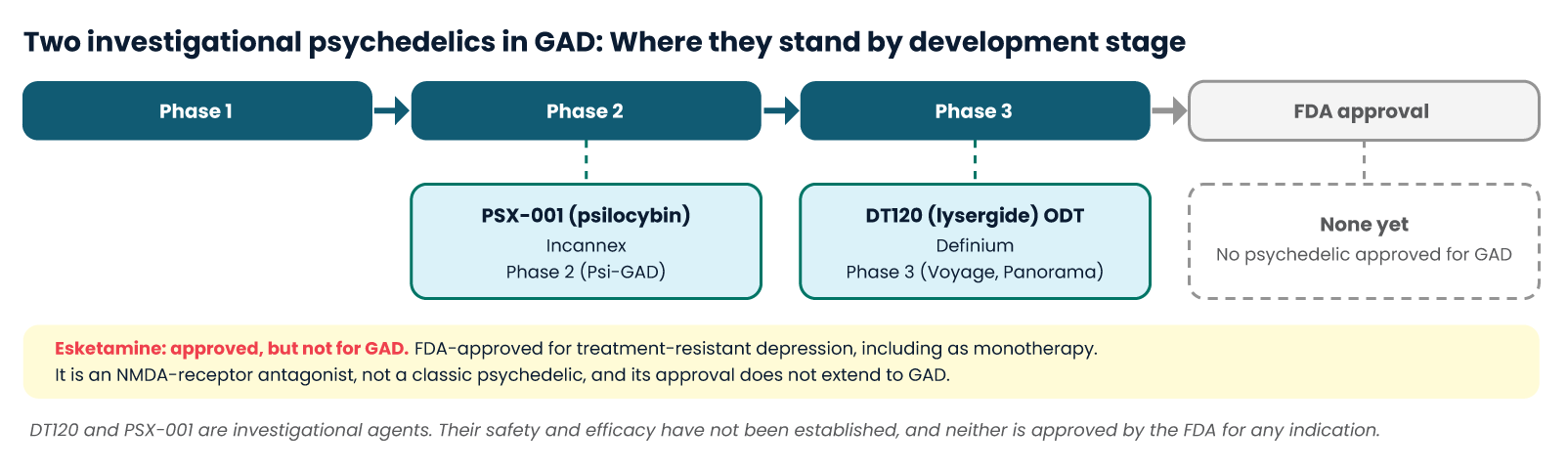
In GAD, the property that would fit this receptor biology is durability. Clinical research in GAD is exploring whether the effects of one or two doses of investigational 5-HT2A agonists can persist beyond the initial treatment period. If they do, that would be consistent with slow 5-HT2A engagement and intracellular signaling producing change that outlasts the drug’s exposure. How receptor kinetics, signaling, and cellular location contribute to any longer-lasting effects is still being studied, and further clinical research will determine how consistently such effects can be sustained in GAD.
Three targets, one downstream destination: How current and investigational approaches engage the brain, by mechanism
| First-line SSRIs / SNRIs | Classic Psychedelics | Esketamine | |
| Target and action | Serotonin (and norepinephrine) transporter; reuptake inhibition | 5-HT2A receptor agonist; Gq coupling; slow receptor dissociation; the plasticity-relevant receptors sit inside the neuron | NMDA receptor antagonist on inhibitory interneurons; disinhibits glutamate |
| Link to plasticity | Delayed, direct TrkB binding also reported | Direct: neuroplasticity associated with TrkB, mTOR, and AMPA signaling | Indirect via glutamate: AMPA, BDNF, mTORC1 |
| Dosing and onset | Daily; benefit over weeks | Single or a few doses, depending on the agent | Repeated (twice-weekly induction, then maintenance); rapid onset |
| Status / context | Approved, first-line for GAD | Agents are currently under investigation; none are approved for treatment | Approved for treatment-resistant depression |
| Sources: Kim 20201; Wacker 20172; Vargas 20233; van Hoogdalem 20264. | |||
References
- Kim K, Che T, Panova O, et al. Structure of a Hallucinogen-Activated Gq-Coupled 5-HT2A Serotonin Receptor. Cell. 2020;182(6):1574-1588.
- Wacker D, Wang S, McCorvy JD, et al. Crystal Structure of an LSD-Bound Human Serotonin Receptor. Cell. 2017;168(3):377-389.
- Vargas MV, Dunlap LE, Dong C, et al. Psychedelics promote neuroplasticity through the activation of intracellular 5-HT2A receptors. Science. 2023;379(6633):700-706.
- van Hoogdalem MW, Fu DJ, Drevets WC, Zannikos PN. Esketamine Nasal Spray: Mechanism of Action, Clinical, and Translational Science. Clin Transl Sci. 2026;19:e70527.