

Find more articles on this and other psychiatry and CNS topics:
The Journal of Clinical Psychiatry
The Primary Care Companion for CNS Disorders
Neuroimaging and pathohistologic research may show whether bipolar disorder is a degenerative and progressive condition, if detectable changes in the brain record past occurrences, and whether these changes are reversible. Interpreting neuroimaging studies has been complicated by a lack of identification of patient mood states and differences in patients’ medication status, but several observations have been made. Pathohistologic research suggests that bipolar disorder is associated with significant cell pathology.
From the Editors

Are you a healthcare provider?
Add your NPI to personalize your JCP experience.
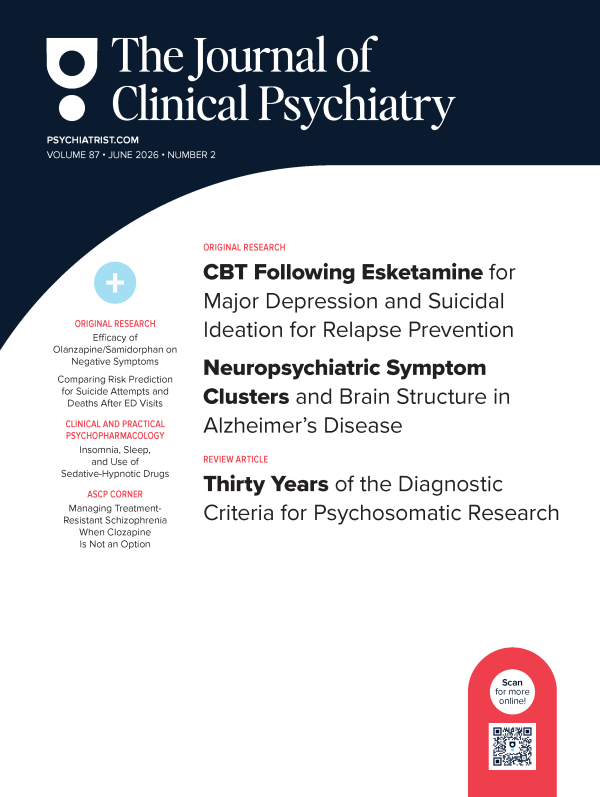
Vol 87 • 2026 • Number 2
Read the Current Issue
Original Research
CBT following Esketamine for Major Depression and Suicidal Ideation for Relapse Prevention: The CBT-ENDURE Randomized Trial
Original Research
Neuropsychiatric Symptom Clusters and Brain Structure in Alzheimer’s Disease
Systematic Review
Thirty Years of the Diagnostic Criteria for Psychosomatic Research
Original Research
Efficacy of Olanzapine/Samidorphan on Negative Symptoms
Original Research
Comparing Risk Prediction for Suicide Attempts and Deaths After Emergency Department Visits
Clinical and Practical Psychopharmacology
Insomnia, Sleep, and the Use of Sedative-Hypnotic Drugs: Practical Notes
Learn More About Psychedelics in Psychiatry
Explore the Collection