
Lessons Learned at the Interface of Medicine and Psychiatry
The Psychiatric Consultation Service at Massachusetts General Hospital sees medical and surgical inpatients with comorbid psychiatric symptoms and conditions. During their twice-weekly rounds, Dr Stern and other members of the Consultation Service discuss diagnosis and management of hospitalized patients with complex medical or surgical problems who also demonstrate psychiatric symptoms or conditions. These discussions have given rise to rounds reports that will prove useful for clinicians practicing at the interface of medicine and psychiatry.
Prim Care Companion CNS Disord 2026;28(5):26f04247
Author affiliations are listed at the end of this article.
From the Editors

Are you a healthcare provider?
Add your NPI to personalize your JCP experience.
Have you ever felt isolated in your clinical practice setting? Have you been unsure about how you might establish or enhance your interactions with coworkers at the local, regional, or national level? Have you felt that you were missing out on opportunities for comradery and lifelong learning because you were the only provider in your specialty in your practice setting? If you have, the following case vignette and discussion should prove useful.
CASE VIGNETTE
Dr A, a consultation-liaison (C-L) psychiatrist, was named as the Chief of Psychiatry at a large metropolitan Veterans Affairs medical center. Its C-L service was staffed by 2 attending psychiatrists that supported a medically complex inpatient population, including individuals with severe mental illness, substance use disorders, and multiple chronic medical comorbidities. As Chief, Dr A’s responsibilities increasingly shifted toward direct care of patients with prominent social factors that impacted care (including housing insecurity and homelessness, financial insecurity, and social isolation), with limited opportunities for informal case discussion and collegial collaboration.
During this period, one of the attending psychiatrists took extended family leave, leaving the C-L service understaffed. The remaining clinicians faced a growing consult volume, increasing medical complexity of patients during the COVID-19 pandemic, and limited opportunities for shared decision-making. Although each psychiatrist continued to provide high-quality care, clinical work became increasingly siloed. Informal peer consultation, once a routine part of daily practice, became infrequent, and opportunities for mentorship and collaborative problem-solving diminished.
In response to these challenges, Dr A and the other attending psychiatrist on the service reached out to colleagues through national professional networks, including the Academy of Consultation-Liaison Psychiatry Special Interest Groups. These discussions provided practical guidance on staffing models and clinical workflows, including the integration of advanced practice providers and the development of a proactive C-L model.
Over time, these external connections evolved into regular, structured meetings with peers across institutions. Many of the other psychiatrists described practicing as the sole or one of a few C-L psychiatrists in their settings, often without access to academic offerings (eg, grand rounds, journal clubs) or consistent collegial support. These meetings became a forum for case discussions, shared learning, and professional connections. What began as an effort to address local staffing constraints developed into a broader collaborative network that fostered scholarship, mentorship, and collective problem-solving, as well as a renewed sense of professional connection and meaning.
DISCUSSION
Why (and How Often) Do Health Care Providers Practice Alone or in Very Small Groups?
Over the past few decades, physicians in the United States have been transitioning from working in predominantly independent practices to larger, integrated systems. Longitudinal data have demonstrated a consistent decline in solo and small-group practices in favor of larger groups and employed models. Data from the American Medical Association Physician Practice Benchmark showed an 18% decrease in physicians who work in private practice, with nearly half (47.4%) practicing in groups of 10 or fewer physicians in 2024, compared to nearly two-thirds (61.4%) in 2012, and around 80% in the 1980s. Solo practice rates have also declined significantly; recent estimates have shown that approximately 12% of physicians worked in solo practices in 2024 as compared to 18% in 2012.1 More recent claims-based data confirm this trend: Among Medicare beneficiaries, the proportion of primary care visits delivered by solo practitioners decreased from 33.4% in 2012 to 24.7% in 2022.2
Practice sizes vary by specialty and geography. Studies have identified higher rates of solo family medicine practices in rural areas and among physicians with more than 30 years in practice.3,4 Similarly, specialty-specific data have shown declining rates of solo practices across multiple fields, including dermatology, radiation oncology, and surgical specialties.1,5,6 Trends among newly certified internists have also reflected this shift, with a move away from outpatient-only practice toward hospitalist roles, declining from 71% to 8% between 2008 and 2018.7 In addition, specialties (eg, cardiology, oncology, hospice, and palliative care) and hospital-based disciplines are increasingly integrated into large health systems. These findings reflect broader trends in health care consolidation, including hospital acquisitions of physician practices, expansion of larger multispecialty groups, and growth of employed physician models.8
Despite these trends, some physicians opt for solo practices or small practices for several reasons, including greater professional autonomy, perceptions of higher job satisfaction, improved work-life balance, and the ability to provide more continuity of care, although this is often at the cost of lower income and greater administrative burdens. Independent practice allows physicians to control their clinical decision-making, scheduling, and organizational priorities without a bevy of institutional constraints.
Solo and small practices often facilitate closer, longitudinal relationships with patients. Smaller panel sizes and reduced organizational complexity have allowed physicians to deliver personalized care and maintain continuity, which are frequently cited as professional and ethical motivations for independent practice.4 Older physicians and those with longer tenures in practice have tended to remain in solo or small-group settings, which has reflected both historical training models and established practice ownerships.3,4 In contrast, newly graduated or younger physicians have increasingly favored employed models due to financial pressures and lifestyle considerations.3,5
While solo practices have offered potential financial autonomy and revenue control, they have carried substantial financial risk. Among physician practices sold between 2014 and 2024, the 3 primary drivers for transitioning from private ownership to entity ownership were the need to negotiate higher payment rates with payers, to improve access to costly resources, and to better manage payer’s regulatory and administrative requirements.1 Solo practitioners have borne full financial responsibility for practice operations, including fluctuations in patient volume, reimbursement changes, and staffing costs. These pressures have continued to drive consolidations into larger systems. Educational debt and reimbursement uncertainty further discouraged entry into solo practice among younger physicians.
Independent practices have also faced disproportionate administrative burdens, including billing, regulatory compliance, and electronic medical records implementation. These challenges have limited the adoption of quality improvement initiatives.9 Evidence-based practices that support improved patient outcomes, such as measurement-based care, have been implemented less frequently in solo and small-group psychiatric settings, in part due to resource constraints and limited technological infrastructure.10
Interestingly, practice size has complex relationships with physician well-being. Some data have suggested that burnout rates in solo practices have been lower than those in system-owned practices, possibly due to greater autonomy.11 However, administrative burden and isolation may offset these benefits in other contexts.
Alternative practice models have also emerged that may allow physicians to remain independent while mitigating some of the administrative burdens traditionally associated with solo practice. Concierge and membership-based practices are often comprised of solo physicians or small groups who may employ other physicians, nurse practitioners, counselors, and allied health professionals. These models can provide greater freedom from administrative requirements, particularly when physicians do not participate in insurance-based reimbursement, while preserving opportunities for close longitudinal relationships with patients and families. Some concierge practices maintain nonexclusive affiliations with larger health care systems or networks that provide electronic medical record support, referral pathways, and access to laboratory and imaging services. Such hybrid arrangements may allow physicians to retain control over practice size, scheduling, and professional commitments while benefiting from selected resources typically associated with larger health organizations.
A recent systematic review found that concierge and direct primary care models were associated with high levels of physician and patient satisfaction, improved access and continuity of care, and reduced administrative demands.12 However, these findings also highlight that practice structure exists along a continuum rather than a simple dichotomy between independent and integrated care models. As such, the risk of practicing in silos may be influenced not only by practice ownership or size but also by the degree of connection to broader professional networks and collaborative environments.
What Are the Advantages and Disadvantages of Solo (or Small) Practices?
Solo or small practice settings offer several advantages with respect to patient experiences, continuity of care, physician satisfaction, and quality of care. Patients in solo or smaller practices rate their care higher on visit quality, appointment wait times, telephone access, and interpersonal care. 13,14 These practices also receive higher ratings for service, accessibility, and practice facilities, despite lower cost infrastructures.15 These settings also facilitate continuity of care, with physicians with smaller practices reporting longer patient relationships than physicians in larger group practices, as longevity of patient relationships appears to decrease as the size of a practice panel grows.16–18
Physician ownership and smaller practice structures correlate with better professional and organizational outcomes. Physician-owned practices tend to improve the quality of care provided while reducing burnout.19 They also show lower overall burnout compared to health system–owned practices, greater satisfaction with electronic health records, and more satisfying work cultures that are marked by effective leadership, teamwork, psychological safety, and learning.11,20,21 Physicians in smaller practices also report greater satisfaction with family time and the quality of care they provide, despite being less satisfied with their lower income, as well as greater autonomy, pride in their work, and a stronger sense of control over their practice environment.16,20
Smaller practices perform about as well as larger ones on most measures, with panel size having minimal impact.22 When supported appropriately, physician-owned practices may engage more actively in quality improvements.19 Overall, solo and small practices can deliver meaningful gains in patient-centered care, continuity, and professional fulfillment.
At the same time, these advantages are accompanied by important tradeoffs. The autonomy, flexibility, and local control that characterize smaller practices can convey less access to real-time peer consultation, mentorship, and shared decision-making.11,23 This leaves clinicians at risk for professional isolation and increased cognitive and emotional burdens.24,25
Opportunities for informal learning, case discussions, and scholarly collaborations may be reduced, and clinicians may be more vulnerable to burnout, particularly in the setting of high clinical demand or limited staffing.11,26,27 The relationship between autonomy and burnout is nuanced. While physicians in solo practices report less burnout than those in small group or health system–owned practices (adjusted odds ratio [OR]=1.71 for 2–5 physician practices vs solo and 1.42 for system-owned vs physician-owned), they have less access to clinical knowledge support, which reflects a tradeoff between logistical autonomy and access to peer expertise.11,23
Social isolation carries measurable harm. For each 1-point increase in the social isolation score, the odds of burnout rise by 10%, while diminished professional fulfillment increases by 11% and suicidal ideation by 9%.24 Physicians are also more likely to feel isolated than workers in other fields (OR=1.28).24 This underscores the need to deliberately build external networks and collaborative structures, even for experienced clinicians who may otherwise experience increasingly siloed practice.25,27
Effective countermeasures include peer support programs, small-group physician meetings, professional coaching, and informal consultation networks.28–31 Self-facilitated small-group meetings have been associated with reductions in burnout (12.7%) and depressive symptoms (12.8%) over 6 months.30 Peer support programs improve well-being, reduce stigma, and foster positive cultural change.28 Informal consultation is more common in group practice settings, where proximity and shared incentives facilitate collaboration.25 Professional coaching has also demonstrated reductions in emotional exhaustion and overall burnout.29
Finally, system-level interventions that target workload and organizational culture are more effective than individual-level interventions alone.32,33 Organization-directed strategies demonstrate greater reductions in burnout compared to physician-directed interventions.33 Promoting physician well-being requires shared responsibility between individuals and health care organization, with attention to both practice environment and individual needs.26,34
Overall, the relationship between practice size and burnout appears multifactorial. While smaller and physician-owned practices may promote autonomy, continuity of care, and professional fulfillment, burnout risk is also influenced by practice structure and access to professional support. Hybrid models, including concierge and membership-based practices that maintain connections to larger health care networks, may preserve many of the benefits of independent practice while reducing some of the administrative and professional challenges associated with practicing alone. As a result, burnout risk may depend less on practice size itself and more on the extent to which clinicians remain connected to supportive professional, academic, and interdisciplinary networks.
What Contributes to Feeling or Being Isolated From Other Health Care Providers?
Training of health care providers is often grueling while learning to navigate long work hours, and high-stakes situations within complicated hierarchical systems can be daunting. Fortunately, friendships forged in this demanding process make the experience endurable. Camaraderie enhances resilience through the gauntlet of sleepless nights, life and death situations, webs of complex patients, uncertainty, and depression.
However, not every trainee forms these nurturing bonds and effortlessly coalesces with others into a tight-knit unit. Untreated psychiatric conditions, especially social anxiety disorder, often interfere with cohesion, furthering alienation and loneliness. Social anxiety and self-efficacy have an inverse relationship, and the fear of negative evaluations can become crippling within the intense training environment.36
Emotional numbing and cognitive distortions that may coincide with depression can also impede the formation of friendships within training program, increasing feelings of despondency and isolation.37 These conditions frequently worsen upon completion of training, when recent graduates unknowingly accept positions in which supportive colleagues are difficult to find and new colleagues do not look out for one another.38 Early career health care providers who secure an embedded position within another medical specialty may find it more isolative than collaborative.
Military physicians often operate in unique environments where the rigor of military service dovetails with the stress of clinical practice. Deployments frequently remove them from their primary support systems (including family, friends, and colleagues) and thrust them into unstable environments where they face danger and difficult clinical scenarios. Maintaining excellent clinical care when rapidly transitioning from peacetime to wartime provides new opportunities and challenges. In addition, such deployments can create situations in which clinicians must treat comrades in arms as patients amidst the exposure to combat trauma. These charged situations can provoke stress, loneliness, and isolation.39
Where (and to Whom) Can You Turn to Discuss Challenging Cases and Learn How to Improve Your Clinical Practice? (While Addressing Countertransference Issues and Maintaining Confidentiality)
The most reliable sources of clinical support in resource-limited or siloed practice settings are usually structured, confidential, professional communities that employ a layered approach (eg, with small-group peer consultation, continuing medical education [CME], formal supervision, mentorship, Balint-oriented groups, tele-mentoring, or secure virtual communities of practice [VCoPs]). For immediate diagnostic or therapeutic questions, telephone-access specialty consultation remains a viable and practical approach.40
Small-group peer consultation and CME activities help clinicians who feel professionally isolated, since rural physicians report lower morale and more professional isolation than their urban peers. They describe locally delivered small-group CME as being responsive to their learning needs despite barriers associated with travel and access.41,42 Such groups deliver content and provide a recurring peer forum in which clinicians can compare approaches, test their judgment, and normalize uncertainty in the face of managing difficult cases.41,42 When the goal extends beyond receiving advice to facilitate longitudinal professional development, formal supervision or mentorship becomes valuable. High-quality supervision emphasizes reflection, a secure supervisory relationship, and exposure to best-practice models.43 In the field of psychiatry, it has strengthened clinical competence and supported life-long learning.44
When difficult cases are influenced as much by the doctor-patient relationship as by diagnosis or treatment, Balint groups (named after Michael Balint, the psychoanalyst who, with Enid Balint, began case-discussion seminars for general practitioners in London in the 1950s) are especially valuable.45,46 Balint groups are facilitated small-group discussions in which clinicians present challenging cases and reflect on the emotional, relational, and interpersonal dynamics of their encounters.47,48 The Balint group literature consistently describes these groups as helping clinicians examine the clinician-patient relationship, tolerate uncertainty, and reflect on the emotional meaning of their clinical work.47–49 General practitioners have described Balint participation as beneficial—and at times essential—to job satisfaction and endurance in practice. Online Balint formats appear to be feasible for geographically isolated clinicians.48,50 This makes Balint-style work especially relevant when clinicians need a confidential setting in which to process the emotional and counter-transferential aspects of difficult cases.47–51
For clinicians without ready access to local subspecialty colleagues, hub-and-spoke tele-mentoring models offer a practical way to discuss complex cases while improving care locally. One prominent example of this is Project Extension for Community Healthcare Outcomes (ECHO), which links community clinicians with specialist teams through recurring case-based videoconference sessions.52–55 In its original hepatitis C study, outcomes achieved by primary care clinicians at rural ECHO sites were comparable to those at a university specialty clinic.52 Addiction-focused applications are especially relevant to primary care practices: ECHO participation has been associated with greater buprenorphine prescribing by primary care clinicians, and the model has also been adapted for alcohol use disorder management.53–55 These findings make ECHO attractive in siloed settings because it combines case consultation, CME, and professional connectedness within 1 recurring structure.51–55
VCoPs can complement formal tele-mentoring by creating ongoing opportunities for discussion and knowledge exchange across geographic distances. In Australian general practitioner training, a secure online community enrolled 82% of eligible trainees, and most of the surveyed users reported feeling more supported in their practice.56 Others have suggested that participation in VCoPs depends heavily on trust, facilitation, and fit with a clinician’s workflow.57 If digital case discussion is used, it should occur in closed professional settings designed for clinical exchange, not as an open social media or casual messaging network. Such platforms can support case-based discussion while protecting privacy and confidentiality.58 Lo and colleagues59 emphasized that necessary clinical communication should be guided by professional judgment rather than by an overly rigid reading of the Health Insurance Portability and Accountability Act. In practice, this means minimizing sharing of personal health information, limiting disclosure to what is necessary for consultation or learning, and favoring secure professional forums over public channels.58,59
No single resource is sufficient for every clinician or case. For physicians who practice in isolated settings, the most useful model is likely to be layered, including ready access to telephone or specialist input for urgent questions; recurrent peer, supervisory, or Balint structures for longitudinal learning and reflective practice; and ECHO or VCoP participation when geography limits access to expertise.40–42,44,47–50,52–59 Such a portfolio addresses central problems of siloed practice: the cognitive problem of limited access to consultation and the emotional problem of professional isolation. It also provides a practical framework for discussing difficult cases, improving clinical practice, and processing countertransference while maintaining confidentiality through bounded, professionally governed channels.41,48,52,56,58,59
To Whom Can You Turn to Unburden Yourself to Avoid Engaging in Boundary Crossings and Violations?
The concept of boundary maintenance, crossings, and violations can be traced to the Hippocratic Oath, which established early principles of beneficence and nonmaleficence, emphasized professional obligations (such as maintaining confidentiality), and outlined expectations for the physician’s conduct and relationship with patients that align with what is now understood as professional boundaries.60 Professional boundaries are fundamental to safe and ethical psychiatric practice, yet they extend well beyond the patient-physician relationship and into interactions with colleagues, trainees, and institutional systems. When clinicians lack appropriate avenues to process stress, uncertainty, or emotional burden, the risk of boundary crossings and violations increases.61 Since then, “boundary drift” has been described as a potential deviation from one’s internal compass over time that can include contemplation of potential boundary crossings or behaviors that are close to the original boundary. The question of whom one can turn to when unburdening oneself is, therefore, not simply a matter of personal well-being but a core element of maintaining professional integrity.
Professional boundaries have been defined as the “edge” of appropriate professional behavior, maintaining the psychological and social distance necessary to preserve objectivity and protect patients (and colleagues or trainees) from the inherent power differential in clinical or training relationships.61 This relationship requires that physicians prioritize patient and trainee/colleague welfare above personal needs and remain vigilant to conflicts of interest. In psychiatry, these dynamics are intensified by the emotional depth and longitudinal nature of treatment, as well as the impact of care and education, the potential for transference and countertransference, and idealization of mentors, which can blur professional roles if not appropriately managed.60
Importantly, boundary challenges are not limited to patient care. They arise frequently in interactions with colleagues, especially in hierarchical relationships such as supervisor-trainee or attending-resident dynamics. Power differentials in these relationships can create vulnerability, particularly when individuals feel unable to seek support or disclose uncertainty.61 Similarly, “corridor consultations,” requests for informal prescribing, or dual relationships in small or specialized practice settings introduce ambiguity that can erode professional boundaries over time.
Risk factors for boundary violations include life stressors, professional transitions, loneliness, and difficulties with limit setting.60 Notably, clinicians who believe they are immune to such risks may be particularly vulnerable. In modern practice, additional complexities arise from communication, social media, and evolving models of care, all of which require nuanced judgment and adaptability.
Given these risks, identifying appropriate avenues for support is essential. The literature consistently emphasizes the importance of consultation, supervision, and peer support.60 Engaging with trusted colleagues, mentors, or supervisors allows clinicians to process challenging clinical situations, explore countertransference, and receive guidance on boundary management. Institutional culture also plays a critical role. Environments that promote psychological safety, open dialog, and collaborative practice reduce the likelihood that clinicians will operate in isolation. In contrast, siloed systems, whether due to workload, hierarchy, or structural barriers, can increase stress and limit access to support, thereby heightening the risk of boundary drift.61
Ultimately, maintaining professional boundaries requires ongoing self-awareness, reflection, and engagement with others. Psychiatrists and primary care practitioners must recognize their own vulnerabilities and actively seek support before boundary concerns escalate. Turning to appropriate sources (eg, colleagues, supervisors, structured consultation, professional organizations) serves not only to protect the clinician but also to uphold the integrity of the therapeutic relationship and ensure high-quality patient care and professional thriving.
What Can You Do to Establish or Enhance Your Interactions With Coworkers at the Local, Regional, or National Level?
For clinicians practicing or who are considering practicing in smaller, resource-limited, or semi-isolated settings, developing and sustaining professional connections can be challenging. Unlike large academic departments with readily available colleagues, informal consultation, and structured mentorship, physicians in smaller practices require the infusion of intentional effort to establish professional networks. Clinicians must seek out and cultivate these relationships, often outside of traditional institutional structures, and conceptualize networking as a core component of professional practice rather than as an ancillary activity. A practical starting point is identifying areas of intellectual and professional curiosity; clinical interests, systems-level concerns, or advocacy priorities can help direct engagement to specific organizations. Although many of the opportunities described below rely on volunteer participation that is frequently uncompensated, these roles often provide access to colleagues, mentorship, and professional community. Purposeful engagement with peers at the local, state, regional, and national levels can reduce professional isolation, support clinical decision-making, enhance professional fulfillment, and contribute to long-term practice sustainability (Table 1).
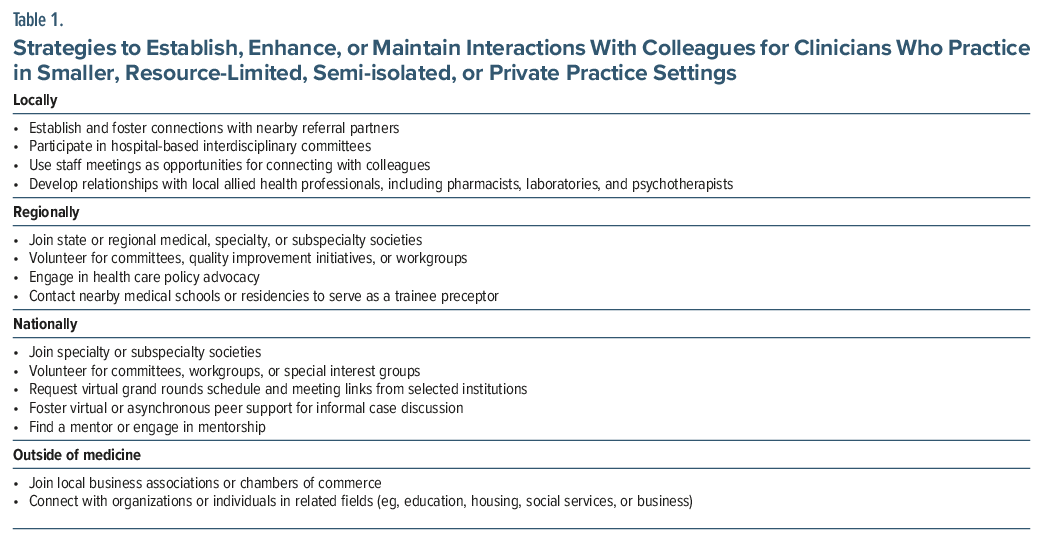
At the local level, clinicians in smaller practices must often establish collegial relationships that would otherwise be embedded within larger institutions. Connections with nearby referral partners can provide clinical support and reduce isolation. Direct outreach, such as with informal conversations in person or virtually, can be effective for establishing rapport. Establishing relationships with allied health professionals (including pharmacists, laboratories, and psychotherapists) further supports integrated care and professional connections. For physicians who work in independent or small group practices, involvement in local professional organizations, business associations, or chambers of commerce may offer additional resources and opportunities for engagement beyond the clinical setting.
Within smaller hospitals or health care systems, interdisciplinary engagement is particularly important, as effective practice is often relationship driven. Required staff meetings, although administrative, may also serve as social or professional touchpoints. Participation in interdisciplinary committees can broaden exposure to colleagues across specialties and facilitate supportive collaborations. Clinicians may further strengthen local networks by engaging with other specialties within the same institution, serving as preceptors or supervising resident clinics, and partnering with nearby medical schools or residency programs, which may also provide access to academic resources, such as medical libraries and CME.
State and regional medical societies provide an important bridge between local practices and national professional communities. Membership in state medical associations and specialty societies connects clinicians with peers who are navigating similar regulatory, reimbursement, and operational challenges. These organizations also offer pathways into health policy and advocacy, enabling clinicians to engage directly with policymakers. Participation through political action committees, policy forums, or legislative observation provides insight into health care policy decision-making processes, and many state-level proceedings are publicly accessible or available virtually, reducing barriers to involvement.
National professional organizations play a key role in maintaining academic and professional identity for clinicians practicing outside of large institutions. Specialty and subspecialty societies often support committees, workgroups, and special interest groups that facilitate collaboration across practice settings. Engagement in shared projects, such as guideline development, educational initiatives, or quality improvement efforts, can foster durable professional relationships and sustain intellectual engagement. Clinicians in smaller and community-based practices bring systems-level insight, continuity of care expertise, and operational perspectives that are highly valued across health care organizations.
Maintaining relationships with colleagues from training and professional organizations provides additional peer support. Informal peer consultations or group supervision, conducted virtually or asynchronously, allows clinicians to compare experiences across practice settings and mitigate isolation. Many academic departments also offer grand rounds or educational programming that is open to external clinicians, supporting continued exposure to current scholarship. Mentorship programs within professional organizations, as well as direct outreach through professional digital platforms, may further support clinicians who are navigating transitions into smaller practice environments.
Meaningful professional engagement may also occur outside of traditional academic medicine. Because health care intersects with education, housing, public policy, and business, participation in organizations addressing these broader systems can be invaluable. Such involvement may deepen understanding of the contexts in which patients live and health care is delivered, while fostering connections with professionals who share systems-oriented perspectives. For clinicians who work in smaller settings, these roles may complement academic engagement and support a more integrated professional identity.
Professional isolation is a recognized challenge in smaller practice settings, but it is not an inevitable consequence of working outside of large academic centers. By intentionally cultivating connections at the local, regional, and national levels, clinicians can develop professional networks that provide intellectual stimulation, collegial support, and career sustainability. Approaching professional connections as a deliberate rather than a passive benefit of institutional affiliation supports a sustainable experience in smaller clinical settings.
What Happened to Dr A?
Over time, Dr A’s engagement with national colleagues evolved from seeking guidance to fostering collaboration. Through sustained participation in these networks, she contributed to the development of a more structured and proactive C-L model within her institution, while also helping to cultivate regular forums for peer interactions across sites. These efforts were associated with increased scholarly activity, including collaborative writing and dissemination of clinical innovations. In parallel, experiences caring for patients with significant social vulnerability, as well as practicing within a professional isolated environment, informed Dr A’s growing role as an advocate for individuals at risk for marginalization—both patients and clinicians. This advocacy extended to broader institutional and professional settings, including initiatives focused on access, equity, and transparency within clinical care, education, and organizational practices. Dr A described a renewed sense of professional connection and purpose, as the isolation of siloed practice gave way to a community of shared inquiry. This experience was accompanied by growth not only in clinical expertise but also in leadership, particularly in building teams, motivating others, and developing systems that support both patient care and clinician well-being. The work, while initially driven by necessity, became a source of sustained professional fulfillment.
CONCLUSION
Although solo or small practice settings tend to facilitate better patient experiences, continuity of care, physician satisfaction, and quality of care, these practice settings increase feelings of isolation and burnout and create obstacles to peer supervision, mentorship, scholarly collaborations, and lifelong learning. Practitioners in these environments must work to develop external networks and collaborative relationships. Balint groups, in which clinicians present challenging cases and reflect on the emotional, relational, and interpersonal dynamics of their encounters, consistently help clinicians examine the clinician-patient relationship, tolerate uncertainty, and reflect on the emotional meaning of their clinical work; this promotes self-awareness and support, while mitigating burnout. Given the risks associated with small or siloed practices, identifying appropriate avenues for support, consultation, supervision, and peer support is essential. Engaging with trusted colleagues, mentors, or supervisors allows clinicians to process challenging clinical situations, explore countertransference, and receive guidance on boundary management. Environments that promote psychological safety, open dialog, and collaborative practice reduce the likelihood that clinicians will operate in isolation.
Article Information
Published Online: September 22, 2026. https://doi.org/10.4088/PCC.26f04247
© 2026 Physicians Postgraduate Press, Inc.
Submitted: April 6, 2026; accepted June 18, 2026.
To Cite: Matta SE, Raffoul JJ, Boone L, et al. Practicing in resource-limited and siloed settings: the impact of isolation on morale, clinical care, and lifelong learning. Prim Care Companion CNS Disord 2026;28(5):26f04247.
Author Affiliations: Massachusetts General Hospital/Harvard Medical School, Boston, Massachusetts (Matta, Stern); VA Palo Alto Health Care System, Palo Alto, California (Raffoul); Department of Psychiatry and Behavioral Sciences, Stanford University School of Medicine, Stanford, California (Raffoul); Harry S. Truman Veteran’s Administration Hospital, Columbia, Missouri (Boone); Department of Psychiatry, University of Missouri Medical School, Columbia, Missouri (Boone); Bayhealth Medical Center, Dover, Delaware (DeSimone); Department of Mental Health and Behavioral Sciences, James A. Haley Veterans Administration Hospital, Tampa, Florida (Bobonis Babilonia); Department of Psychiatry and Behavioral Neurosciences, University of South Florida, Morsani College of Medicine, Tampa, Florida (Bobonis Babilonia); Department of Psychiatry and Behavioral Sciences, Emory University School of Medicine, Atlanta, Georgia (Schwartz); Grady Memorial Hospital, Atlanta, Georgia (Schwartz).
Corresponding Author: Sofia E. Matta, MD, Massachusetts General Hospital/Harvard Medical School, Boston, Massachusetts ([email protected]).
Matta, Raffoul, Boone, DeSimone, Bobonis Babilonia, and Schwartz are co-first authors; Stern is the senior author.
Financial Disclosure: Drs Raffoul and Bobonis Babilonia are employed by the US Department of Veterans Affairs, but the opinions expressed in this article do not reflect those of the Department of Veterans Affairs. Dr Stern has received royalties from Elsevier for editing textbooks on psychiatry. Drs Matta, Boone, DeSimone, and Schwartz have no disclosures or conflicts of interest.
Funding/Support: None.
Clinical Points
- Effective countermeasures against isolation and burnout associated with practice in small or siloed settings include peer support programs, small-group physician meetings, professional coaching, and informal consultation networks.
- Reliable sources of clinical support in resource-limited or siloed practice settings tend to involve use of structured, confidential, professional communities that employ a layered approach (eg, with small-group peer consultation, continuing medical education, formal supervision, mentorship, Balint-oriented groups, tele-mentoring, or secure virtual communities of practice).
- Although no single resource is sufficient for every clinician or case, physicians who practice in isolated settings value ready access to telephone or specialist input for urgent questions, recurrent peer, supervision, or Balint groups for longitudinal learning and reflective practice.
References (61)

- Kane C. Physician Practice Characteristics in 2024: Private Practices Account for Less Than Half of Physicians in Most Specialties. American Medical Association Policy Research Perspectives. https://www.ama-assn.org/system/files/2024-prp-pp-characteristics.pdf
- Bond A, Schpero W, CiveleK Y, et al. Changes in primary care practice setting and practice type for Medicare beneficiaries. JAMA Health Forum. 2025;6(4):e250445. PubMed
- Jetty A, Petterson S, Jabbarpour Y. Proportion of family physicians in solo and small practices is on the decline. J Am Board Fam Med. 2021;34(2):266–267. PubMed
- Liaw W, Jetty A, Petterson S, et al. Solo and small practices: a vital, diverse part of primary care. Ann Fam Med. 2016;14(1):8–15. PubMed
- Watson A, Eckerson A, Brodell R, et al. Advantages and disadvantages of private vs academic dermatology practices. CUTIS Cutan Med Pract. 2025;116(2):29–33.
- Lu S, Sindhu K, Rowley J. Changes in employment and practice locations among radiation oncologists: 2015-2023. Int J Radiat Oncol Biol Phys. 2025;122(5):1095–1101. PubMed
- Gray B, Vandergrift J, Stevens J, et al. Evolving practice choices by newly certified and more senior general internists: a cross-sectional and panel comparison. Ann Int Med. 2022;175(7):1022–1027. PubMed
- Beaulieu N, Chernew M, Willimas M, et al. Organization and performance of US health systems. JAMA. 2023;329(4):325–335. PubMed
- Rao S, DesRoches C, Donelan K, et al. Electronic health records in small physician practices: availability, use, and perceived benefits. J Am Med Inf Assoc. 2011;18(3):271–275.
- Ridout KK, Vanderlip E, Carlo AD, et al. Considerations for implementation of measurement-based care: focus on solo and small-group practitioners. Psychiatr Serv. 2025;76(7):665–674. PubMed
- Ewards A, Marino M, Balasubramanian B, et al. Burnout among physicians, advanced practice clinicians and staff in smaller primary care practices. J Gen Int Med. 2018;33(12):38–46.
- Rylands KS, Collins CM, Collins DR Jr. Maximizing the value of concierge medicine: a systematic review of cost, access, and outcomes. Am J Med. 2025;138(9):1201–1213.
- Holdroyd I, Chadwick W, Harvey-Sullivan A, et al. Single-handed versus multiple-handed general practices: a cross-sectional study of quality outcomes in England. J Health Serv Res Pol. 2024;29(3):201–209.
- Rubin HR, Gandek B, Rogers WH, et al. Patients’ ratings of outpatient visits in different practice settings. Results from the medical outcomes study. JAMA. 1993;270(7):835–840.
- van den Hombergh P, Engels Y, van den Hoogen H, et al. Saying ’goodbye’ to single-handed practices; what do patients and staff lose or gain?. Fam Pract. 2005;22(1):20–27.
- Paddock E, Prince RJ, Combs M, et al. Does micropractice lead to macrosatisfaction?. J Am Board Fam Med. 2013;26(5):525–528.
- Dahrouge S, Hogg W, Younger J, et al. Primary care physician panel size and quality of care: a population-based study in Ontario, Canada. Ann Fam Med. 2016;14(1):26–33.
- Devlin RA, Hogg W, Zhong J, et al. Practice size, financial sharing and quality of care. BMC Health Serv Res. 2013;13:446.
- Rotenstein LS, Cohen DJ, Marino M, et al. Association of clinician practice ownership with ability of primary care practices to improve quality without increasing burnout. JAMA Health Forum. 2023;4(3):e230299.
- Rotenstein LS, Apathy N, Landon B, et al. Assessment of satisfaction with the electronic health record among physicians in physician-owned vs non-physician-owned practices. JAMA Netw Open. 2022;5(4):e228301.
- Cuellar A, Krist AH, Nichols LM, et al. Effect of practice ownership on work environment, learning culture, psychological safety, and burnout. Ann Fam Med. 2018;16(Suppl 1):S44–S51.
- Gravelle H, Liu D, Santos R. How do clinical quality and patient satisfaction vary with provider size in primary care? Evidence from English general practice panel data. Soc Sci Med. 2022;301:114936. CrossRef
- Lin KY. Physicians’ perceptions of autonomy across practice types: is autonomy in solo practice a myth?. Soc Sci Med. 2014;100:21–29.
- West CP, Dyrbye LN, Sinsky CA, et al. Social isolation and burnout, professional fulfillment, and suicidal ideation among US physicians. Mayo Clin Proc. 2025;S0025-6196(25):00414–00418.
- Keating NL, Zaslavsky AM, Ayanian JZ. Physicians’ experiences and beliefs regarding informal consultation. JAMA. 1998;280(10):900–904.
- West CP, Dyrbye LN, Shanafelt TD. Physician burnout: contributors, consequences and solutions. J Intern Med. 2018;283(6):516–529.
- Agarwal SD, Pabo E, Rozenblum R, et al. Professional dissonance and burnout in primary care: a qualitative study. JAMA Intern Med. 2020;180(3):395–401.
- Tolins ML, Rana JS, Lippert S, et al. Implementation and effectiveness of a physician-focused peer support program. PLoS One. 2023;18(11):e0292917.
- Dyrbye LN, Shanafelt TD, Gill PR, et al. Effect of a professional coaching intervention on the well-being and distress of physicians: a pilot randomized clinical trial. JAMA Intern Med. 2019;179(10):1406–1414.
- West CP, Dyrbye LN, Satele DV, et al. Colleagues meeting to promote and sustain satisfaction (COMPASS) groups for physician well-being: a randomized clinical trial. Mayo Clin Proc. 2021;96(10):2606–2614.
- Russell B, Ahmadzadeh A, Haris K, et al. Peer support programs for physicians and health care providers: a scoping review. Jt Comm J Qual Patient Saf. 2025:S1553-7250(25)00144-8.
- Guille C, Sen S. Burnout, depression, and diminished well-being among physicians. N Engl J Med. 2024;391(16):1519–1527.
- Panagioti M, Panagopoulou E, Bower P, et al. Controlled interventions to reduce burnout in physicians: a systematic review and meta-analysis. JAMA Intern Med. 2017;177(2):195–205.
- Brazeau CMLR, Trockel MT, Swensen SJ, et al. Designing and building a portfolio of individual support resources for physicians. Acad Med. 2023;98(10):1113–1119.
- Winkel AF, Honart AW, Robinson A, et al. Thriving in scrubs: a qualitative study of resident resilience. Reprod Health. 2018;15(1):53.
- Heimberg RG, Hofmann SG, Liebowitz MR, et al. Social anxiety disorder in DSM-5. Depress Anxiety. 2014;31(6):472–479.
- Kupferberg A, Hasler G. The social cost of depression: investigating the impact of impaired social emotion regulation, social cognition, and interpersonal behavior on social functioning. J Affective Disord Rep. 2023;14.
- Pfifferling JH. The danger of a dysfunctional medical practice. Fam Pract Manag. 2005;12(5):40–44.
- Ghorbankhani M, Mousavian S, Shahriari A, et al. Psychological coping mechanisms in military physicians: a qualitative exploration of stress management strategies. J Mil Veterans’ Health. 2025;33(3):15–21.
- Smego RA, Khakoo RA, Burnside CA, et al. The benefits of telephone-access medical consultation. J Rural Health. 1993;9(3):240–245. PubMed
- Dowling S, Last J, Finnegan H, et al. Impact of participation in continuing medical education small group learning (CME-SGL) on the stress, morale, and professional isolation of rurally-based GPs: a qualitative study in Ireland. BJGP Open. 2019;3(4):bjgpopen19X101673. PubMed
- Dowling S, Last J, Finnegan H, et al. Does locally delivered small group continuing medical education (CME) meet the learning needs of rural general practitioners?. Educ Prim Care. 2019;30(3):145–151. PubMed CrossRef
- O’Sullivan B, Hickson H, Kippen R, et al. Exploring attributes of high-quality clinical supervision in general practice through interviews with peer-recognised GP supervisors. BMC Med Educ. 2021;21(1):441. PubMed
- Senediak C, Bowden M. Clinical supervision in advanced training in child and adolescent psychiatry: a reflective practice model. Australas Psychiatry. 2007;15(4):276–280. PubMed
- Salinsky J. The Balint movement worldwide: present state and future outlook: a brief history of Balint around the world. Am J Psychoanal. 2002;62(4):327–335. PubMed
- American Balint Society. Our Society and Its History [Internet]. American Balint Society; 2026. https://www.americanbalintsociety.org/history_emeritus.php
- Clarke D, Coleman J. Balint groups. Examining the doctor-patient relationship. Aust Fam Physician. 2002;31(1):41–44. PubMed
- Kjeldmand D, Holmström I. Balint groups as a means to increase job satisfaction and prevent burnout among general practitioners. Ann Fam Med. 2008;6(2):138–145.
- Keinänen M. Cooperation between mental health professionals and doctors in a Balint-oriented supervision group. Isr J Psychiatry Relat Sci. 2001;38(2):95–101. PubMed
- Koppe H, van de Mortel TF, Ahern CM. How effective and acceptable is Web 2.0 Balint group participation for general practitioners and general practitioner registrars in regional Australia? A pilot study. Aust J Rural Health. 2016;24(1):16–22. PubMed CrossRef
- Marshall AA, Smith RC. Physicians’ emotional reactions to patients: recognizing and managing countertransference. Am J Gastroenterol. 1995;90(1):4–8.
- Arora S, Thornton K, Murata G, et al. Outcomes of treatment for hepatitis C virus infection by primary care providers. N Engl J Med. 2011;364(23):2199–2207. PubMed
- Solmeyer AR, Berger AT, Barton SL, et al. Association of Project ECHO training with buprenorphine prescribing for opioid use disorder. JAMA Health Forum. 2022;3(11):e224149. PubMed
- Anderson JB, Martin SA, Gadomski A, et al. Project ECHO and primary care buprenorphine treatment for opioid use disorder: implementation and clinical outcomes. Subst Abus. 2022;43(1):222–230. PubMed
- Mahadevan J, Shukla L, Chand PK, et al. Innovative virtual mentoring using the Extension for Community Healthcare Outcomes model for primary care providers for the management of alcohol use disorders. Indian J Med Res. 2020;151(6):609–612. PubMed CrossRef
- Barnett S, Jones SC, Caton T, et al. Implementing a virtual community of practice for family physician training: a mixed-methods case study. J Med Internet Res. 2014;16(3):e83. PubMed
- Murad A, Lederman R, Bosua R, et al. Enhancing general practitioners participation in a virtual community of practice for continuing medical education: an exploratory study. Stud Health Technol Inf. 2017;239:97–103.
- Coles RA, Goh SJ, Livingstone D, et al. MedShr: improving patient care through clinical case discussion. Minerva Cardioangiol. 2020;68(3):175–187. PubMed
- Lo B, Dornbrand L, Dubler NN. HIPAA and patient care: the role for professional judgment. JAMA. 2005;293(14):1766–1771.
- Friedman SH, Martinez RP. Boundaries, professionalism, and malpractice in psychiatry. Focus Am Psychiatr Publ. 2019;17(4):365–371. PubMed
- Lampe L, Hitching R, Hammond TE, et al. Being a “good” doctor: understanding and managing professional boundaries is challenging and can lead to stress and burnout. Australas Psychiatry. 2023;31(6):764–767. PubMed
Please sign in or purchase this PDF for $40.